Building Bridges Through Landmark Moments
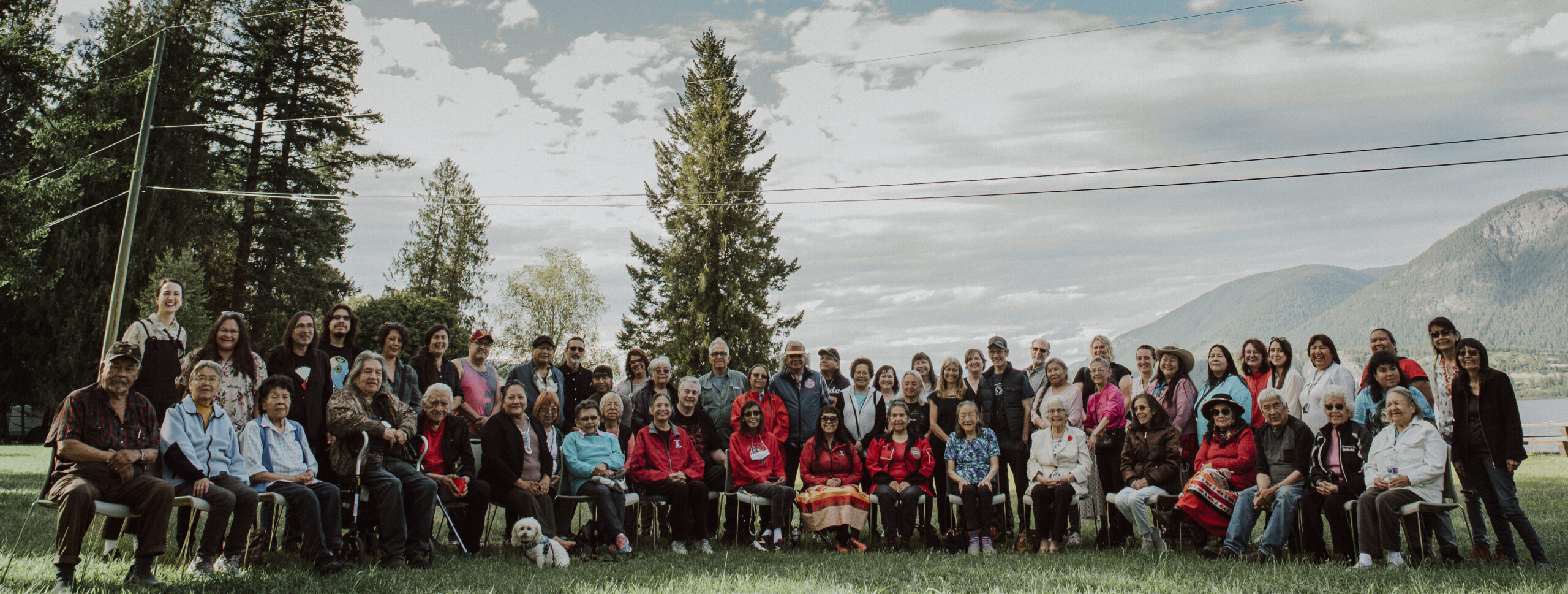
Since time immemorial the Secwépemc people have used landmarks to relay information about their traditional territory in the southern interior of BC. To those that knew the signs, carefully balanced stones, piles of dirt and pictographs marked the edge of territory, good fishing spots and other important details.
Today, with the help of municipal governments in the Shuswap region, the Secwépemc are erecting landmarks again, but now they are a sign of bridge-building between communities.
“The landmarks show the relationship between Indigenous and non-Indigenous–everyone working together,’ says Shelley Witzky, a member of the Adams Lake Indian Band, one of 32 bands within the Secwépemc Nation. “That’s part of reconciliation.”
Origins from across the ocean
What has become known as the Secwépemc Landmarks Project started when Witzky learned about an obelisk in New Zealand that was part outdoor sculpture and part signpost pointing out important places to the Indigenous Maori people. Knowing the Secwépemc’s history of using landmarks, she thought it would be an interesting project to create something similar. Witzky consulted Secwépemc’s elders and worked with the Shuswap Trails Alliance (STA), the trail planning organization in the area, to develop a proposal. Together they took the idea of building the first landmark in Salmon Arm’s Wharf and Marine Peace Park to the city council.
Salmon Arm had fielded many previous suggestions for installations in the waterfront park, says Gary Buxton, the director of planning and community services for the city. This request was unanimously embraced.
“Council and staff, we had no hesitation in supporting the installation,” Buxton says. “This was an opportunity for us to acknowledge the history of our two communities and for the Secwépemc to see themselves on the landscape and in our community.”
Landmarks of Learning
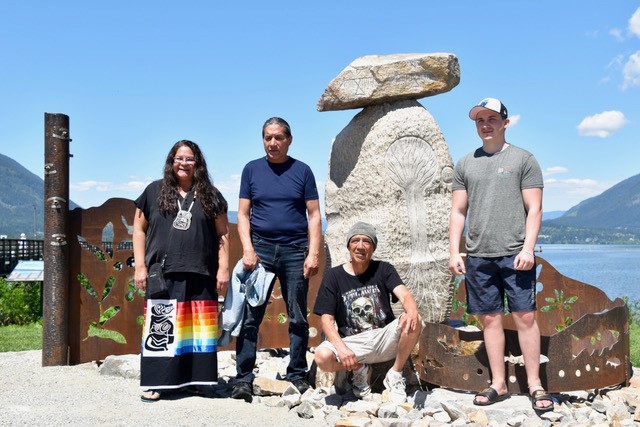
The Sxwetsméllp Landmark now sits near the main boat launch in Salmon Arm. It consists of a horizontal stone balanced on a larger vertical stone, like the ones the Secwépemc traditionally used to mark their territory. Next to it is a bronze sculpture, made by two Indigenous and one settler artist, that includes a post directing the viewer to nine important Secwépemc locations within the view scape.
The STA and Witzky have now partnered with other municipalities in the area, including the Shuswap Regional District and the town of Chase, to install 16 other landmarks.
“Anywhere we wanted to put up a sculpture, we just asked and everyone jumped on board,” says Witzky.
They also worked with Indigenous schools and School District 83 to include students in the project. Elders taught 200 students–both Indigenous and non-Indigenous–to carve wooden posts with Secwépemc oral histories, place names and stories. With the help of the STA, and support of land managers, they erected them in parks and trail networks throughout the area.
A view on reconciliation
Both projects help Secwépemc people feel seen and heard, says Juliana Alexander, an elder in the Splatsin band, part of the Secwépemc Nation.
“It builds awareness about us,” she says. “I like to think that the trail posts and landmarks open [people’s] view to who we are and our history on the land.”
Equally important was the willingness of the STA and the municipalities to let the Secwépemc people lead the project, says Witzky.
“They let us be in the driver seat,” says Witzky. “Other groups I’ve worked with see us as victims. They find solutions for us. We need to find them for ourselves. They sat in the navigator seat and helped us get where we wanted to go.”
About the Author
Ryan Stuart has two loves: being active, especially outdoors, and writing. His best days combine the two. Ryan is a contributor to many outdoor and adventure sport magazines and websites and writes blog posts and hosts webinars for the Outdoor Recreation Council of BC. He’s based in the Comox Valley on Vancouver Island. You can follow his work on Instagram @Ryan_adventures